
Co-ordination and Balance
We all need co-ordination to complete everyday tasks and Pilates was specifically designed to improve co-ordination of the entire body.
Co-ordination is the ability to move different body parts together smoothly and efficiently in a controlled way. From hand-eye co-ordination to mind-body co-ordination, we all need it to complete everyday tasks. While for sporting activities, co-ordination is crucial to improve training performance and to achieve consistently better results because it is a foundation for many activities.
Challenging our co-ordination when exercising can improve our performance in everyday tasks. It improves our control of different movements and helps with our balance. It allows us to focus and connect to our body to be aware of what is moving, and what we are keeping still.
For sports people co-ordination can help with technique, control and form in different activities. If we are more in control of your body and more aware of what it is doing, our joints are more stable enabling us to apply ourself better, thus improving our performance.
Pilates was specifically designed to improve co-ordination of the entire body challenging us to co-ordinate tasks such as stabilising the spine while combining leg and arm movements. It also helps to build more muscle because we can control and slow down movements rather than use momentum.
Pilates encourages the co-ordination of breath with the exercise getting them to work together, connecting our mind to our body and thereby allowing us to find a flow and control of different movements.
As such Pilates co-ordination work can enhance mood and mental health as it takes concentration and mindfullness to be in the present and focus on the task we are doing.
Opposite arm and leg work in Pilates gives us better balance and better control of our body which can help prevent injury. For example, a standing balance move where we lift opposite arm and leg. The co-ordination gives us better control, while the balance strengthens the tendons and ligaments around our hips, knees and ankles which gives us more stability.
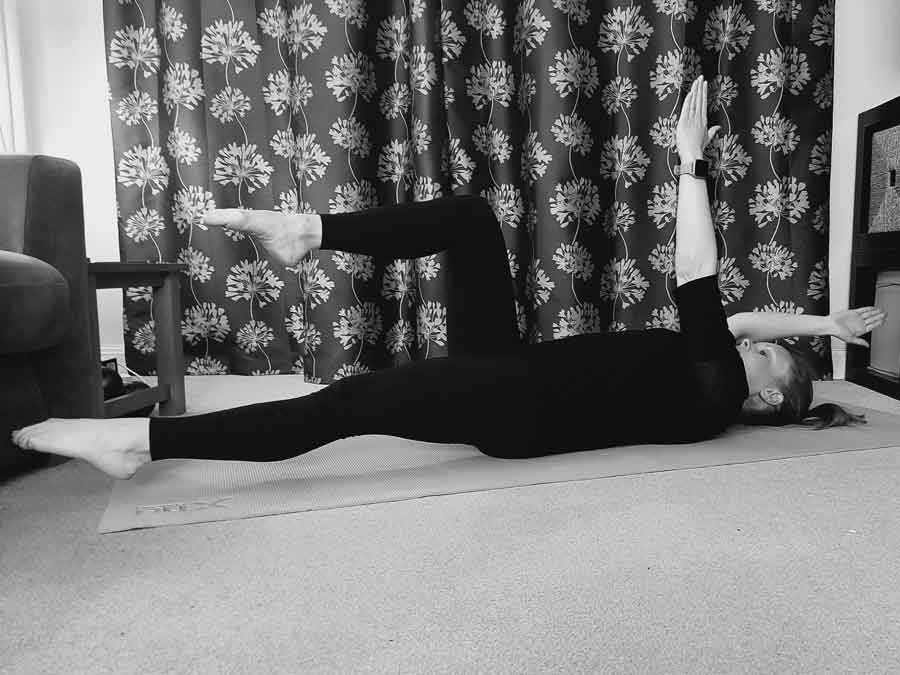
The single leg stretch (pictured) is a core strength movement but we can add co-ordination by adding an opposite arm stretch. This gives us something else to think about. Getting the connection makes us more body aware.
The swimming exercise (pictured) strengthens muscles either side of spine and glutes starting with just our leg then adding an element of challenge to our coordination and balance by lifting the opposite arm.
"Pilates is the complete co-ordination of mind, body and spirit."
Joseph Pilates